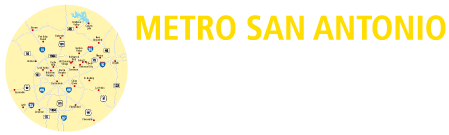
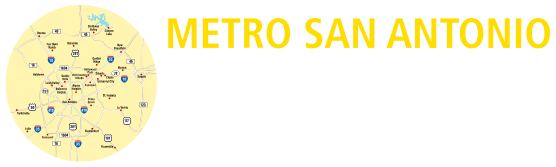

All that said, a surprise newcomers find when they get here is the ease with which we travel around our city, notwithstanding the constant construction on our highways. With a major network of interstate highways, local roads, 11,666 total centerline miles to be exact, it is possible to drive from the very northernmost reaches of the city to downtown during rush hours in 25 minutes or less.
Four interstate highways bisect San Antonio, arguably more than any other city in the country. IH-10, which runs east to west along the southern tier of the U.S. from Jacksonville FL to Los Angeles CA, enters the city from Seguin, forty miles to the east and Boerne, 40 miles to the west. It runs along the near west and south sides of the city while skirting the downtown area.
IH-35 travels south starting in Duluth MN. It enters San Antonio on the northeast side, coming to us most immediately from New Braunfels, 30 miles to the northeast, splitting our midsection north of downtown and continues through the city on the near west side, where for 6 miles it shares right-of-way with IH-10. It then continues on to Laredo, 170 miles to the southwest on the border with Mexico.
U.S. Hwy 281, which also comes through the city from the north, having started its long journey at the Canadian border in North Dakota, also splits San Antonio, running through some of the most picturesque if not contentious sections of the city. Past Olmos Basin, Brackenridge Golf Course and the San Antonio Zoo, just north of downtown, it picks up IH-37 south of the city. At a point, the two highways split with IH-37 heading to Corpus Christi on the Gulf of Mexico, 143 miles away, and Hwy 281, traveling border-to-border, ends its own journey in Brownsville deep in the Rio Grande Valley, 280 miles away.
And U.S. Hwy 87 starts its almost 2000 mile journey in Havre, Montana, passing through Cheyenne, Denver, Colorado Springs, and Lubbock TX before entering San Antonio on its way to Port Lavaca on the Texas Gulf coast.
But the two roadways that make San Antonio unique and convenient are its inner (John B. Connally) Loop 410 and outer (Charles W. Anderson) Loop 1604. Connally, a friend of the city was governor of Texas in the early to mid-60s and Anderson was a Bexar (pronounced Bear) County judge from 1939 to 1964.
Loop 410, fully 49.49 miles in circumference, dates to 1959 when the Texas Legislature authorized its construction. It was completed in the early 70s, followed, as it happens, by a major population shift northward.
The first section of Loop 1604 between TX Hwy 16 and Hwy. 281 was completed in 1963. The entire roadway, 69 miles in circumference, was completed by 1975. A two-lane country road, it has seen the University of Texas at San Antonio, the city’s only 4-year public university, open in 1972, and Rogers Ranch and Stone Oak, among other subdivisions, spring up in increasing numbers. Loop 1604, now six lanes wide, “talks” of further increases.
And speaking of two-lane country roads, Texas Hwy. 46, running through some of the most pristine sixty-five country miles between Hwy 16 west of Boerne and Hwy. 123 in Seguin, with stops in Bulverde, Spring Branch and New Braunfels, is on the grow as well. Formerly dotted with 2000-acre ranches in what San Antonio folk believe, even now, is country, this two-lane rural road has seen car counts rise in the last eight years. And with the conversion of many of those ranches into subdivisions, such as Cordillera Ranch, Hwy 46 has been expanded to four lanes.
Air Transportation
San Antonio International Airport (SAT), centrally located in north central San Antonio, is a short drive from most anywhere in the city. Situated at Airport Blvd and Loop 410, it covers 2,600 acres and is the primary airport serving the city and metropolitan area.
SAT is currently in the middle of its largest capital project in history. Construction is underway on a new Terminal, scheduled to open in 2028. This will add up to 17 new gates and a modern Federal Inspection Station for increased international travel.
SAT is served by 14 airlines. For more information, log on to San Antonio International Airport.
Public Transportation
VIA operates 511 buses seven days a week from 5am to 12am. There are 6,853 bus stops along 81 bus lines which are divided into five categories: frequent, metro, express, skip, and flex, and four streetcar routes. For more information, log onto www.viainfo.net.
In total, VIA’s service area is 1,230.98 square miles, which is 99 percent of Bexar County. The service area is made up of the unincorporated parts of the county and the following municipalities: Alamo Heights, Balcones Heights, Castle Hills, China Grove, Converse, Elmendorf, Grey Forest, Kirby, Leon Valley, Olmos Park, San Antonio, Shavano Park, St. Hedwig, and Terrell Hills. Also included are the county portions of Cibolo, Fair Oaks Ranch, and Schertz.
Utilities
The City of San Antonio owns its electric and gas utilities through CPS Energy, and its water and sewer utilities through SAWS. The City publishes the terms and conditions of the utility rates and charges at the following: CPS Rates (Electric and gas service rates). SAWS Rates (Water and sewer service rates).
Telephone and Cable
| Provider | Primary Services | Service Area & Neighborhoods | Website |
| Spectrum | Cable Internet, TV, Phone, Mobile | 92%+ Coverage: Available in nearly every neighborhood citywide. | spectrum.com |
| AT&T Fiber | Fiber/High-Speed Internet, Phone | 86% Coverage: Widespread across the city; highest concentration in established residential areas. | att.com |
| Google Fiber | Fiber Internet, Phone (VoIP) | 30%+ Coverage: Concentrated in West & North San Antonio (Leon Valley, Great Northwest, Churchill Estates). | fiber.google.com |
| Astound Broadband | Fiber-powered Cable, TV, Phone | Select Areas: Strong presence in Central, North, and Northwest San Antonio and Helotes. | astound.com |
| GVTC | Fiber Internet, TV, Phone | Far North: Serves Timberwood Park, Fair Oaks Ranch, Bulverde, and the Hill Country edge. | gvtc.com |
| Verizon 5G Home | 5G Wireless Home Internet, Phone | Citywide: Available wherever 5G mobile coverage is strong; a popular alternative to wired cable. | verizon.com |
Property Taxes
Because there is no personal income tax, property taxes are a major source of funding for local services. They help fund police and fire protection, roadways, and flood control projects, among other things.
Property taxes, administered by county appraisal districts, are ad valorem taxes. They are based on 100% of the current market valuation. In addition to property taxes, appraisal districts collect for other entities. In Bexar County, for instance, that will include taxes for a school district, the County itself, the San Antonio River Authority, Alamo Community College District, the University Health System, municipally funded utility districts and additional city taxes.
New drivers in Texas
The Texas Department of Public Safety requires drivers to get a Texas driver’s license within 30 days of moving. Military and full-time students, however, are exempt from this process. Applicants must bring the following documents to the DPS: proof of social security number, proof of Texas vehicle registration*, proof of auto insurance with personal liability, and a valid out-of-state license.
Metro Area Cities
There are 15 incorporated cities in the San Antonio metro area. The smallest is Grey Forest with 519 residents, and the largest is San Antonio with 1,570,300. The second-largest city is Schertz, with 42,000 residents, while the city with the largest percentage gain in the 2020 Census, Fair Oaks Ranch, a portion of which is in neighboring Kendall County, with 12,648 residents.
The City of San Antonio employs more than 15,920 people and operates with a budget of $4 billion.
The City of San Antonio operates under a council-manager form of municipal government. The City Council comprises 10 representatives elected by district, while the mayor is elected at large. Council members and the Mayor serve a maximum of two four-year terms. The City Council sets policies to be carried out by the City Manager.
Public Library
The San Antonio Public Library first opened in 1903. The system includes the Central Library, 29 branches, and 12 public school/library partnerships.
The 200,000 square-foot Central Library, located downtown at 600 Soledad, opened in 1995. It features a Texana/Genealogy collection, a Latino collection, a gallery showcasing a variety of exhibits, an auditorium that seats 150, private meeting and study rooms, and collections and equipment for special-needs patrons. Overall, the system contains almost 2 million items, including books, videos, CDs, magazines and newspapers, and databases. Computers with internet access are available at all library locations, and free computer classes are offered on a regular basis.
Library cards are free to all Bexar County residents with proof of identity and in-county residence. The Library’s website is www.mysapl.org and the main information number is (210) 207-2500.
Visitor Information
The Visitor Information Center, 110 Losoya St, (210) 244-2000, downtown, directly across from the Alamo, has a wealth of information about the city and surrounding areas. Here you’ll find maps to help you navigate the city.