By Jim LaVilla-Havelin
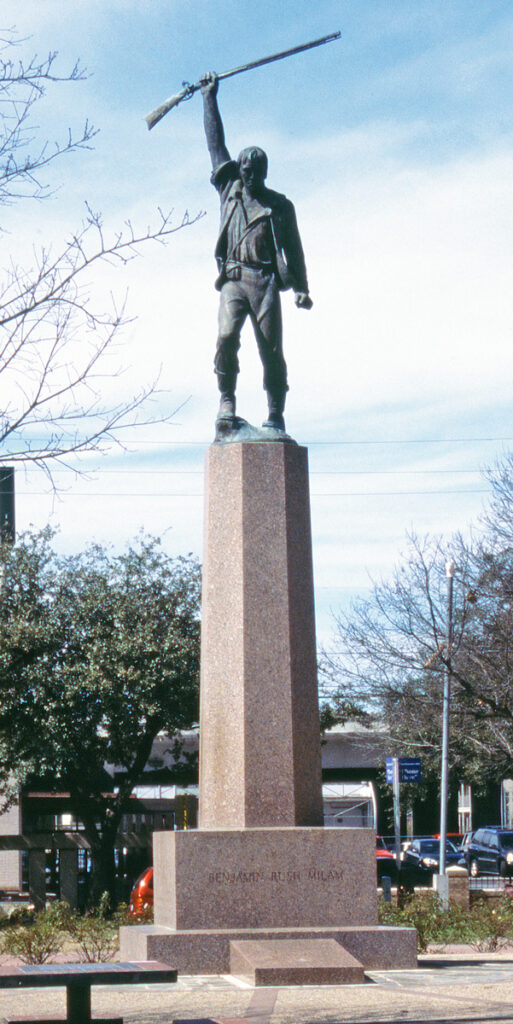
On a walk through downtown the other day, I bumped into three, or was it four bronze figures, mostly in parks, holding forth, commemorated, even put on a pedestal. No one on horseback. But there were Jose Antonio Navarro, San Antonio de Padua, Toribio Losoya, Maury Maverick, Sr., Moses Austin, and an anonymous Conquistador. You could learn some versions of the city’s history and find more than a few street names and named elementary schools among this bunch.
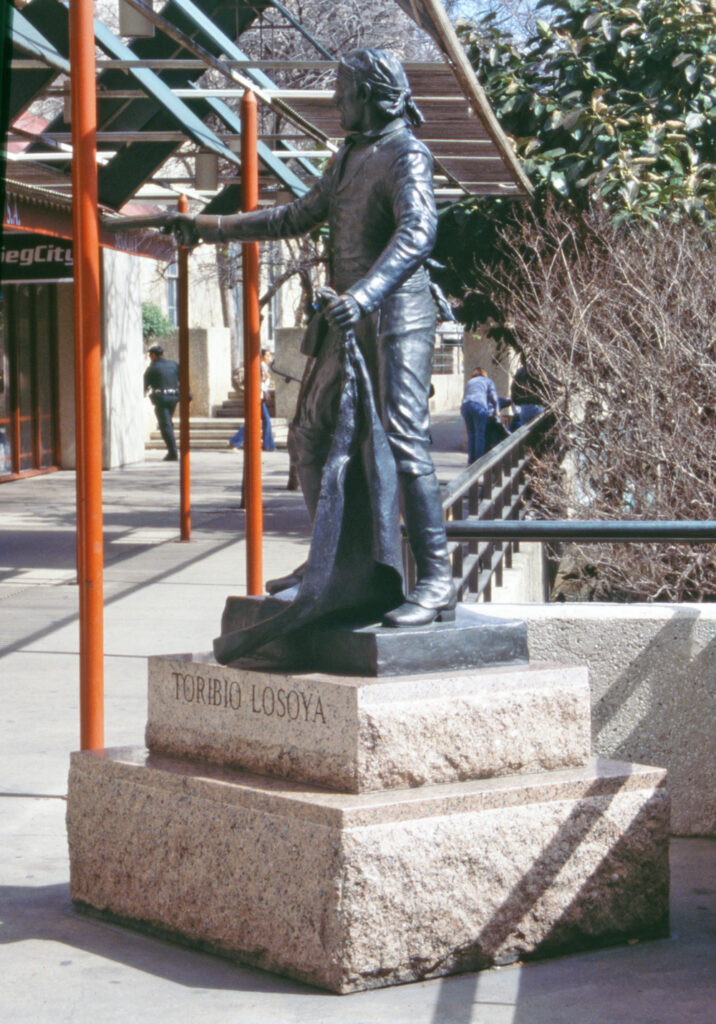
We tend not to do that much of this kind of thing anymore, because we know too much about public figures for art about them ever to be sacred amidst their foibles. As we’ve cut figures down to size, abstractions have taken their place, often monumental, sometimes conceptual, and almost always the topic of a heated exchange on the editorial pages – an exchange about priorities, support for the arts, and understandability/appropriateness. Not a bad set of questions for public art to provoke. It is, after all, public.
In any city, the public art and monuments are a not-so-subtle guide to the powerful and the powerless, the honored, whether honorable or not, and the forgotten. Even in the abstracted, contemporary forms of public art, the questions of power, money, neighborhood, and image cling to the work like so many pieces of flying refuse caught on them in the wind.
I’ll leave it to you to bump into the aforementioned figures as you get to know the city. And just mention one more of note:
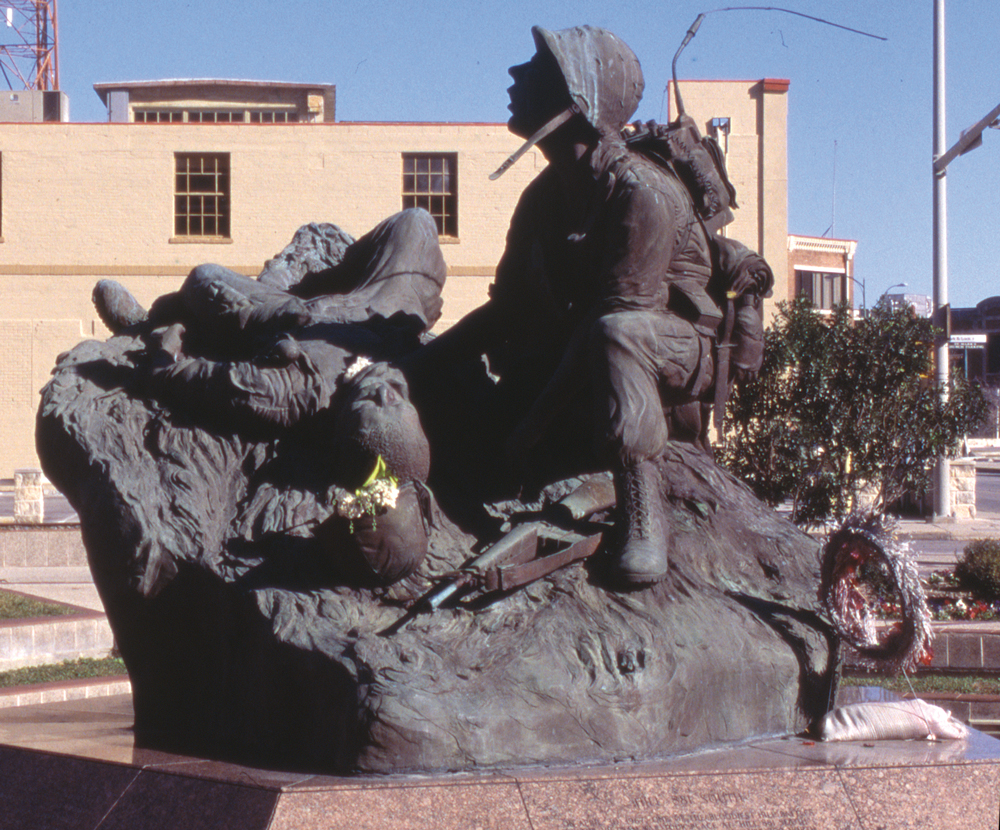
Hill 881 South – our figurative Vietnam Memorial is harrowing testament and an indication of the size and importance of the military in the community, and an interesting contrast with Maya Lin’s controversial, stark Vietnam Veteran’s Memorial in Washington, D.C. (sculptor: Austin Deuel / location: 105 Auditorium Circle, E. Martin & Jefferson Sts..
The distance between commemorative statues and the abstract forms of contemporary sculpture or decorative tile work, narrative/politically charged murals, and buildings with a sculptural presence is a truncated history of art in America. Artist Jose Arpa (1952)’s murals, like those in the lobby of the Express-News office (location: Avenue E & 3rd St.), are one bridge across that divide. Jesse Trevino’s Spirit of Healing mural on the façade of Santa Rosa Hospital (location: W. Houston St., across from Milam Park) and his Our Lady of Guadalupe Veladora at the Guadalupe Cultural Arts Center (location: 1300 Guadalupe Street) are striking examples of public, accessible figurative imagery.
Sebastien’s Torch of Friendship (location: intersection of East Commerce, South Alamo, & Losoya) is best approached by driving West on Commerce. Red-orange metal, monumental, with a twist-curl at the top, recalling an Olympic torch, is viewable as a measure against the buildings, the street, and the shapes of downtown. It holds the space well, is hard to approach as a walker, and is much too fleeting in one’s view of it traveling south down Alamo, too fleeting and too close. But approached from the east, the torch is radiant and somehow both big and delicate, with a color not so different from Ricardo Legoretta’s Central Library building (more on that later)
In the shadow of the torch, on the walls and sidewalks of the trolley stop, Ann Adams’ quilt-like tiles add a lushness of color and geometry to what is otherwise a confused and drab space. They are jewel-like in stark contrast to the stone, a fine example of public art as “design enhancement.”
Jimmy LeFlore, Design Enhancement Program Coordinator in the Public Works Department of the City of San Antonio, notes, “Right now public art seems to be finding its way through various functional and integral manifestations, largely dictated by architectural and engineering development needs.”
Tile work by Malou Flato on Houston Street (location: on the bridge lights at 100 block of E. Houston Street), by the students from ASKEW in The Deco District (location: Fredericksburg Road), and by Oscar Alvarado along the Riverwalk, are contemporary examples of a public art form that is part of a continuum of tile arts in San Antonio, on San Antonio buildings across time. See tilework by Bachelder Tile on the stair risers at The McNay Museum (location: 6000 N. New Braunfels). And murals by, of, and for the community from San Anto Cultural Arts are a treasure of San Antonio’s Westside.
Joel Shapiro’s blue-painted aluminum Untitled, 2000 creeps up the side of the building at The McNay, gravity-defying and delightful. Danville Chadbourne’s Mysterious Conjunction – The Great Myth of Transformation rises on Fredericksburg at Michigan & West French, a remnant, or a visitor – if not figurative, at least gestural. The San Antonio Botanical Gardens have hosted the sculptural work of Chadbourne and then Carlos Cortez. Each work engaged in a dialogue with its site, in this case, nature.
What Bill FitzGibbons accomplishes in light – Light Channels (location: East Commerce & Houston Streets at the I-37 Underpass), others work at in stone, metal, and glass. (Dale Chihuly’s Fiesta Tower in the Central Library is an example of the latter.) They change the way we look at a space. They can be markers, measures, reflectors, timers, juxtapositions, ideas, comments – all taking shape and taking up space. George Cisneros’ multi-screen video installation – In Light of Passing Measures (location: 203 S. St. Mary’s) engages, raises questions, and becomes an ever-changing video-tile mural.
And can one classify public buildings as public art? The Tower Life’s gargoyle drain spouts? The oft-mimicked shape and embattled history that mark the Alamo? The rose window at Mission San Jose? Or Ricardo Legoretta’s enchilada red monumental Central Library, which even raised the visitorship to the library. (location: 600 Soledad) What about the preserved facades of buildings – like the Texas Theater, long gone, but for its decorative façade on Houston Street – public art as urban archeology.
And does public art need to be permanent, frozen in time, constant enough to become encrusted with bird droppings? Isn’t it possible to think of public art in a more fluid context? Parades and floats, gowns and cascarones – fiesta as living public art piece? Or those most fleeting of art forms, each Day of the Dead, the ofrendas, altars, which crop up around the city – both personal and public, both loss and celebration. And gone quickly, yet stitched into memory, community, family, fully in their presence, their multi-sensory appeal, and the presences they wish to invoke.
The best public art changes the way we see, experience, and remember a place. It helps us discover what we might have overlooked and remember what is gone. LeFlore notes, “ There are many well-established relationships between public art and neighborhood revitalization, economic development, cultural identity, and even crime prevention. Public Art can also simply serve as a brief liberation from certain stresses that seem to now be intrinsic to modern life.”
But public art will always be a bone of contention in the art wars, as long as people believe that its presence signals a choice between sidewalks, filled-in potholes, and these incomprehensible (read: useless) objects. That is not the choice. Public education about public art would help – a serious commitment by everyone involved in the dialogue about the why, what, and where of art. A dialogue free of condescension and patronizing attitude on one end, while equally free of fear, false choices, and demagoguery on the other.
In San Antonio, where our public art is so diverse and inclusive, public art’s many voices can, in fact, celebrate more than something as transitory as power and fame – old figures in bronze. They can, with all deference to ambiguity and ambivalence, celebrate something as variously definable as “community.”
Jim LaVilla-Havelin is a poet, critic, and the Director of the Young Artist Programs at the Southwest School of Art & Craft.