

by Dan Calderón
Not so long ago, parents left their preschool-age children at daycare centers that, while safe havens for infants and toddlers, served as little more than babysitting facilities with outdoor playgrounds. Trying to teach children younger than four was a task left to academies that catered to the upper class.
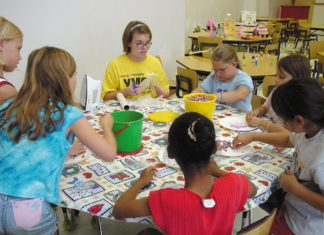
Those days are long gone. In the past decade, largely affordable early childhood learning centers, or early childhood development centers, have replaced daycares. Computers sit alongside traditional finger-painting kits and blocks. Sandboxes dot “outdoor learning areas” instead of playgrounds.
The San Antonio area’s large population of young adults and children is the perfect place for early childhood learning to boom. A plethora of services — from Montessori schools to faith-based learning centers, mom-and-pop childcare facilities to corporate franchises – is available for infants, toddlers, pre-schoolers and their families.
To choose the kind of early childhood learning center best for you and your child, it’s wise to have an understanding of how the profession of early childhood education has evolved, says Mary Ruth Moore, a professor in the Dreeben School of Education at the University of the Incarnate Word.
Moore spent most of her 30-year career in public schools as a first-grade teacher before coming to Incarnate Word. She was among 15 instructors in Texas to be named a Piper Professor in 2003 by the Minnie Stevens Piper Foundation. The award honors superior teaching at the college level.
Current trends in early childhood education and development have been guided by researchers like noted child psychiatrist Dr. Bruce Perry, formerly at the Baylor College of Medicine in Houston from 1992-2001, and the 2000 report “Eager to Learn: Educating Our Preschoolers” from the National Academy of Sciences’ Commission on Behavioral and Social Sciences and Education.
Perry was among the leading researchers to find that the optimum time for brain development is between ages 0 and 3 years. “That doesn’t mean it doesn’t continue to grow after that, but the optimum time is during those young years,” Moore said. The Eager to Learn Report advocated for a balanced approach to early child development involving college-degreed early childhood educators and parental involvement.
The National Association for the Education of Young Children, the nation’s largest and most influential organization of early childhood educators and others dedicated to improving the quality of programs for children from birth through third grade, has worked to guide the profession of early childhood educators toward standardized accreditation. In Texas, the state’s Texas Health and Human Services (HHS) Child Care Regulation has a long list of minimum standards that facilities must adhere to in order to be licensed as a child care center. For example, the state’s disciplinary and guidance standards state that there must be no harsh, cruel, or unusual treatment of any child. The following types of discipline and guidance are prohibited:
- Corporal punishment or threats of corporal punishment.
- Punishment associated with food, naps, or toilet training.
- Pinching, shaking, or biting a child.
- Hitting a child with a hand or instrument.
- Putting anything in or on a child’s mouth.
- Humiliating, ridiculing, rejecting, or yelling at a child.
- Subjecting a child to harsh, abusive, or profane language.
- Placing a child in a locked or dark room, bathroom, or closet with the door closed.
- Requiring a child to remain silent or inactive for inappropriately long periods of time for the child’s age.
“They have helped us to emphasize quality. And then things like state minimum standards have shaped how we work,” Moore said. “But we would also have to acknowledge that the public schools and private schools demand more. Whether we like it or not, we are in a time of emphasis on testing and accountability. So we have had the spotlight shone on us as a profession.”
For some parents, that spotlight will lead them to choose a specific style of early childhood learning. One of the oldest and a widely popular program is the Montessori method, a child-centered curriculum that allows children to develop academically and socially according to their individual abilities instead of following a prescribed curriculum.
San Antonio is home to one of the nation’s first Montessori schools. The Kriterion Montessori School is housed in the quiet, tree-lined neighborhood of Alta Vista, north of downtown San Antonio. Owned and run for four decades by the Laven family, the school’s former administrator, Andreas Laven, was also a former student of Kriterion.
“Children don’t learn the same way we do as adults. As adults, we can recall and apply new information,” he said. “Children discover. Everything goes in like a little sponge, but there’s no filing system, so when it’s time to apply past experience, it’s not always available.”
Kriterion classrooms have traditional Montessori equipment, such as cylinder blocks, towers of cubes and other geometrical shapes. What may appear to be toys are really developmental tools that give children concrete examples of abstract ideals such as images, shapes, colors and numbers.
“The ideals and the equipment have been remarkably unchanged. In fact, a lot of what we have in our classrooms is equipment that we had when we opened the doors,” Laven said.
Moore said such tools are vital for good childhood development. “When I train parents, I say I can guarantee you that you’re child will get to use computers and become adept at them, but I cannot guarantee that every child will get to play with sand, water and blocks enough during those early years,” she said.
“I can’t emphasize this too much. Playing with sand, filling pails, those are pre-math skills. Blocks teach organization, unity, all kinds of mathematic, spatial relations that the child is going to need. Art experiences teach us to be creative, but they also teach us to be more of a human being who appreciates the fine arts,” Moore said.
“We get the cart before the horse sometimes. We need computers, but we also need a balance.”