
By Dan Calderón. This story originally appeared in February 2004 in San Antonio InFocus magazine. Some information may have changed since its original publication.
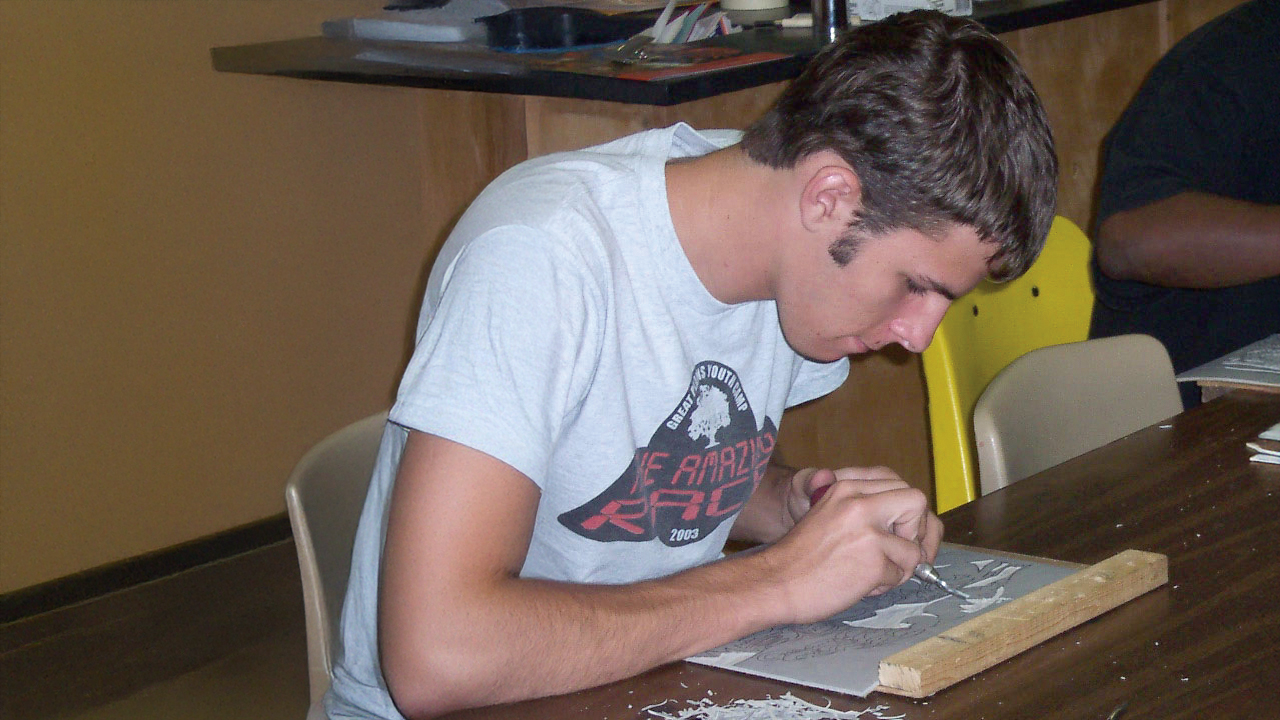
Art education in San Antonio and surrounding communities has long helped students discover their creativity, develop new skills, and find inspiration both inside and outside the classroom.
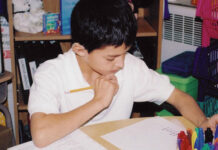
The third-graders in Debbie Badrak’s homeroom class at Watts Elementary School in Cibolo, Texas turned part of their classroom into a beautiful desert landscape last fall. In the spring, it became a lush rainforest, filled with tropical birds and exotic flora.
They made the transformation with paint and canvas under the experienced guidance of Rhea Haxton, or “Granny” as she’s lovingly called by the teachers and students at this campus a short drive northeast of San Antonio.
Haxton retired from her job as a veteran art teacher in the Schertz-Cibolo-Universal City School District 13 years ago. But her passion for teaching art – she wrote the district’s art curriculum standards – was too strong to keep her out of the classroom forever. Haxton has spent the past five years volunteering two days a week, teaching the basics and intricacies of the visual arts to Watts students, including her two grandsons.
“I try throughout the year to let them experience different media, such as chalk, watercolor, paint, cut paper, some tissue paper projects and collage. We work with charcoal, too,” said Haxton, a 74-year-old native of West Virginia. “In the fall, we were studying the work of Georgia O’Keefe, because she had so many desert themes in her work and it fit in with class lessons on the desert. I try to give them a variety.”
This love of variety is thriving in San Antonio-area schools. Although certified art teachers are hard to find in the elementary school levels, volunteers like Haxton and professional development organizations such as the Texas Art Education Association are keeping the visual arts alive and well on campus.
High-stakes testing, teacher shortages and an ever-present funding crisis have put advocates of arts education on alert to watch out for potential cuts to classes in fine arts. But they have succeeded so far in convincing school boards and superintendents of the benefits that arts education, including the visual arts, have to offer students.
According to a report issued in 2002 by the Arts Education Partnership, children who are exposed to arts education may perform better academically than peers who are not exposed to music, dance, drama and the visual arts. The Partnership — a coalition of more than 100 national educational, arts, philanthropic and government organizations, compiled the two-year report “Champions of Change: The Impact of the Arts on Learning” from an analysis of 62 studies by nearly 100 researchers.
The Partnership report specifically said a visual arts background improved content and organization of writing skills; promoted sophisticated reading skills and interpretation of text; and encouraged reasoning about scientific images and reading readiness.
With the focus on academics in mind, visual art educators have sought to complement basics in reading, writing and math through the exploration of art.
“One of the great things about the visual arts is that it teaches problem-solving skills,” said Gloria Hill, Visual Art Coordinator for the North East Independent School District (NEISD). “We encourage all elementary teachers to integrate art into whatever subject matter they teach.”
Hill, who was an art teacher at Bradley Middle School in the NEISD for more than a decade, plays a major part in this philosophy. She works closely with campus-based art coordinators to see how art can play a role in history, English, math and science classes. “If they’re studying the Renaissance Era, or Civil War or biology, there are ways to make art part of the learning equation,” Hill says.
The NEISD is one of Texas’ highest-performing urban school districts year in and year out on standardized tests. So it is telling that district officials place a premium on the arts, as evidenced by the creation of a successful, highly competitive multi-million-dollar magnet school called the North East School of the Arts. Housed at Lee High School, students from all across Bexar County audition every year to enter the NESA programs in dance, music, theatre and visual arts.
“The teachers and administrators understand that visual art is not an isolated extracurricular activity. It’s part of the entire education process, and a valid part,” Hill said. “We teach art history, analysis, judgment and evaluation – all those kinds of things, which are important to any well-rounded academic background.” Students who plan to major in art can get a head start on their college career by taking Advanced Placement art classes, where they can be tested to earn college credit.
The trend toward art integration crosses into private education, also. Christian Heritage Schools is a fairly new private school off Loop 1604 North and U.S. Highway 281 in San Antonio that teaches grades K-10. The early grades boast a robust art curriculum.
The kindergarten crafts program is designed to correlate with classroom lessons. In first grade, students get an overview of art including drawing, architecture, printmaking, weaving, sculpture, painting, and even photography and clothing design.
In second grade, children are learning about how different peoples influenced artistic design across the world, such as Native Americans, Latin Americans, Asians, Europeans and Middle Easterners. The elements of art (line, shape, color, texture, space and form) are brought into the lessons in grade 3. By the time they are in fourth and fifth grades, students are learning about art history from Biblical times to the present and are studying the works of artists such as Michelangelo, Picasso, Van Gogh, Da Vinci, Chagall, and Raphael.
But for students who want to get their hands dirty with paint or clay, art classes remain a good place to explore their creative side. Emette Rivera still remembers the first project he took real pride in – an 8mm movie he created for teacher Richard Brooks’ art class at Harris Middle School using still photos of comic book-style drawings of a skater performing tricks.
“At one point, everyone in class got to show their movie, and I remember thinking how cool it was,” said Rivera, a 1993 Brackenridge High School graduate who has a degree from the Otis School of Design in Los Angeles.
Today, Rivera is a young woodworking artist with a growing reputation as a rising star. He makes his home in Los Angeles, and recently completed a water fountain mosaic that will be featured prominently in “The Terminal,” a Steven Spielberg-directed film starring Tom Hanks and Catherine Zeta-Jones.
“I was very fortunate to have good teachers who pushed me and nurtured me as an artist,” said Rivera, who also credits veteran Brackenridge art teacher Donna Simon. “They really turned on the light for me to show me what was possible.”
Schools are far from the only place where youngsters can pursue the visual arts. San Antonio’s museums regularly hold art camps, and nationally recognized non-profit organizations such as SAY SI also give talented young teens an outlet for their expression.
Located in the Blue Star Arts Complex just south of downtown, SAY SI offers after-school and weekend classes that target inner-city youth, although students from across San Antonio are involved. Students must be accepted into the tuition-free program, now celebrating its 10th year. They also earn profits from the sale of their artwork.
They are also exposed to technology through an adjacent Media Arts Studio, with young people creating websites, stop-motion animation film projects, and working with digital photography and graphic design, said Visual Art Director Victoria Montalto. SAY SI students even put on a garden art show every year, which involves aspects of landscape design.
Although SAY SI’s studio near the streets of downtown San Antonio are a world away from the more rural surroundings that Haxton enjoys at Watts Elementary School, the love of the variety available in the visual arts ties them together.
Recently, the school presented Haxton with a plaque of appreciation with her picture on it, and hung it prominently in the school cafeteria. The wall where it hangs has become a revolving art gallery, where teachers proudly display the best work of their students. It’s a tribute Haxton delights in.
“They call it Granny’s Art Wall, and I think it’s just wonderful,” Haxton says. “I like that they named it after me, but it also shows the children that their creativity is important and appreciated. And that’s what really counts.”