

By Dan Calderón. This story originally appeared September 2003 in San Antonio InFocus magazine. Some information may have changed since its original publication.
Austin is known across the Southwest for its live music scene, but for the best music education scene in the Lone Star State, no place rivals San Antonio.
From elementary school to high school and numerous award-winning off-campus programs, music educators work diligently with youngsters to create great music and to shape future leaders. The musical influence growing up in San Antonio is so strong that the city even has an active marching band made up of adults who used to play in high school marching bands.
The strength of local music education programs shows in the reams of awards, honors and recognitions offered to school groups. An all-girls madrigal choir from Incarnate Word High School recently accepted an invitation to perform for President Bush at a State Department function. A small ensemble from the Youth Orchestras of San Antonio played on the River Walk last year for the prime minister of Spain, and the group is taking a select orchestra to that country this summer for a four-concert tour. The Texas Children’s Choir, based in San Antonio, recorded its first CD last year and was the only U.S. group that French President Jacques Chirac invited to perform in Normandy for official ceremonies commemorating the 60th anniversary of D-Day.
School programs in San Antonio also showcase cultural diversity. Schools in the South San Antonio, Harlandale, Edgewood and San Antonio school districts offer mariachi programs, where students learn to play instruments like the guitarrón and to sing traditional Mexican music.
San Antonio is the place where the best young musicians in the state gather every year to perform for their teachers. The Texas Music Educators Association, a professional organization made up of music instructors including school band, choir and orchestra directors, holds its annual convention in San Antonio every February.
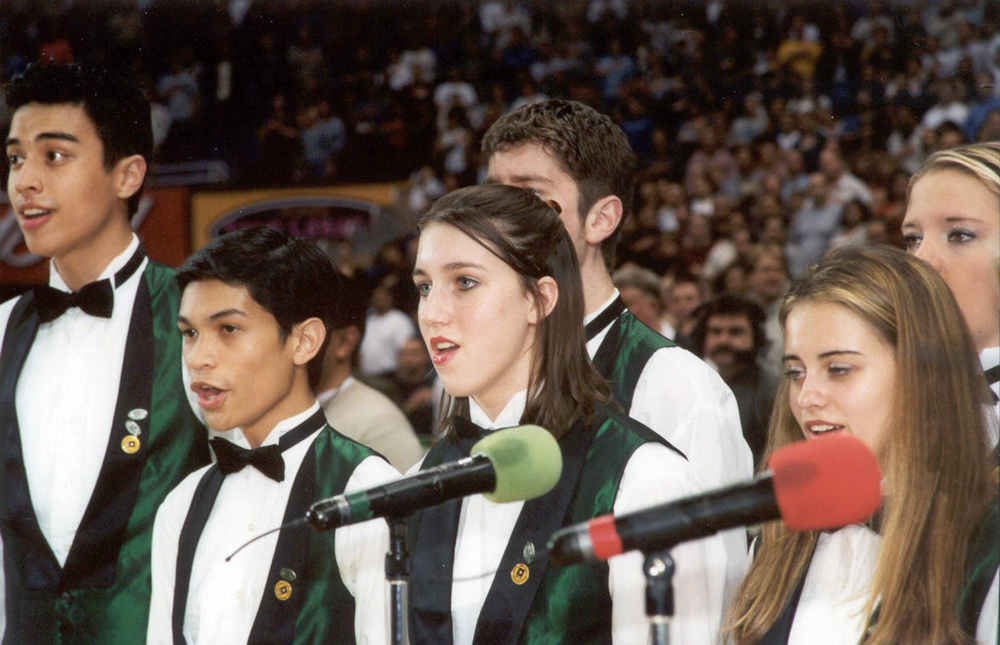
Part of the convention includes performances from the “All-State” band, orchestra, jazz band and choir – groups made up of talented players and singers from all across the Lone Star State. Students are selected for the All-State honor after surviving through three rounds of rigorous auditions.
San Antonio schools are more than a little well-represented in these prestigious groups. This type of individual dedication makes San Antonio music programs strong overall, said Mark Chambers, band director at Reagan High School in the North East Independent School District.
“Band programs have rebuilding years, just like with sports teams, but those individual kids who really go the extra mile and work hard to become better musicians always make for stronger programs,” said Chambers, whose band placed second in the 2003 Bands of America competition in Indianapolis. “We’re fortunate because the area is growing so much, we really don’t struggle to fill out any particular section.”
Students don’t have to be incredibly gifted or talented to be valued contributors in band, Chambers said. “You don’t have to be the world’s greatest player to be really important to the organization,” he said. “Energy and enthusiasm count for a lot, especially in marching band.”
Although mandatory testing in reading, writing and math have become a national norm in public schools, music educators have made strong arguments for the value of their programs. Simply put: Music matters.
According to Americans for the Arts, young people who participate in the arts a minimum of three hours, three days a week for at least one year are four times more likely to be recognized for academic achievement; three times more likely to be elected to class office within their schools; four times more likely to participate in math and science fairs; three times more likely to win an award for school attendance; and four times more likely to win an award for writing an essay or poem.
The Texas Music Educators Association reports that All-State music students consistently score more than 200 points higher on the Scholastic Assessment Test – the nation’s most widely used college entrance exam – than the state averages for their peers, indicating a strong link between top music students and academic standouts.
The proof doesn’t just come from advocacy organizations. Results from a research study published in the March 1999 issue of Neurological Research show that students exposed to music-based lessons scored 100 percent higher on fractions tests than those who learned in the conventional manner.
A February 1997 article in Neurological Research said that a research team exploring the link between music and intelligence found music training is far superior to computer instruction in dramatically enhancing children’s abstract reasoning skills, the skills necessary for learning math and science. Young children with developed rhythm skills perform better academically in early school years, according to research at the University of Central Florida.
Perhaps this mounting evidence is the reason many area schools have pushed for music education in the elementary grades. At Hoffman Lane Elementary School in the Comal Independent School District, Carol Warner is putting her 25 years of experience to the test working with students as young as age 5.
Warner also conducts a choir program that practices before the school day begins, and which has performed at various functions, including a school Veterans’ Day program.
“We’re trying to teach the children to be music readers, to have an appreciation for music, to have an enjoyment for music and be prepared when they move from our school to have a good experience with that,” said Warner, whose campus is located a few miles off Interstate 35 near Canyon Lake. “And we’re fortunate to have instruments for them – xylophones, glockenspiels and metallophones. It’s wonderful to see them improve as the year goes on.”
The learning of fundamentals at an early age can lead to wonderful opportunities to perform abroad just a few short years later. At MacArthur High School, orchestra director Jan Garverick is preparing to take her students on a four-city performing tour of Austria.
“People need to know we have outstanding string programs in San Antonio,” said Garverick, who has been teaching music for three decades. “We have students and parents who are interested in a good overall education.”
Although Texas suffers from a shortage of orchestra teachers, Garverick noted that San Antonio schools have little trouble recruiting and keeping them. “The schools here have cultivated and nurtured good music teachers to stay. They’ve seen to it that we’ve gotten better facilities so we can improve our programs.”
And for students who are considering music education for their future, classes in music theory and even composition are available at many schools, including Advance Placement classes that allow students to test for college credit.
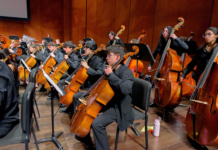
Music is where 16-year-old Briana Quillian sees her future. The clarinet player plays in the orchestra program at a small private school in Boerne, the Vanguard Institute, and with the Youth Orchestras of San Antonio as first chair in the top orchestra, the Philharmonic. YOSA is a non-profit organization that promotes classical music education by bringing students together from all across the San Antonio area to perform in four orchestras, including two full symphony orchestras, and to teach students how to play violin and viola in weekly classes.
“I really want to be a conductor,” said Quillian, whose older brothers played drums and bass guitar in their school programs. “The great thing about playing music at a small school is that all the kids in the music program definitely want to be there. But the down side to it is that if you make a mistake, everyone hears it. In a huge band, you can be out of tune and people may not notice.”